

“A” is for “Attention”
When you attract and sustain someone’s attention, you get very different results than when you force them to sit in front of your screen with their eyes peeled open clockwork orange style. When you attract someone’s attention they’re going to want to stick around to see what you have to say; their curiosity is piqued, their radars are up, and they want to know what’s going to happen next.
From The Accidental Instructional Designer by Cammy Bean, 2014 (p. 81)
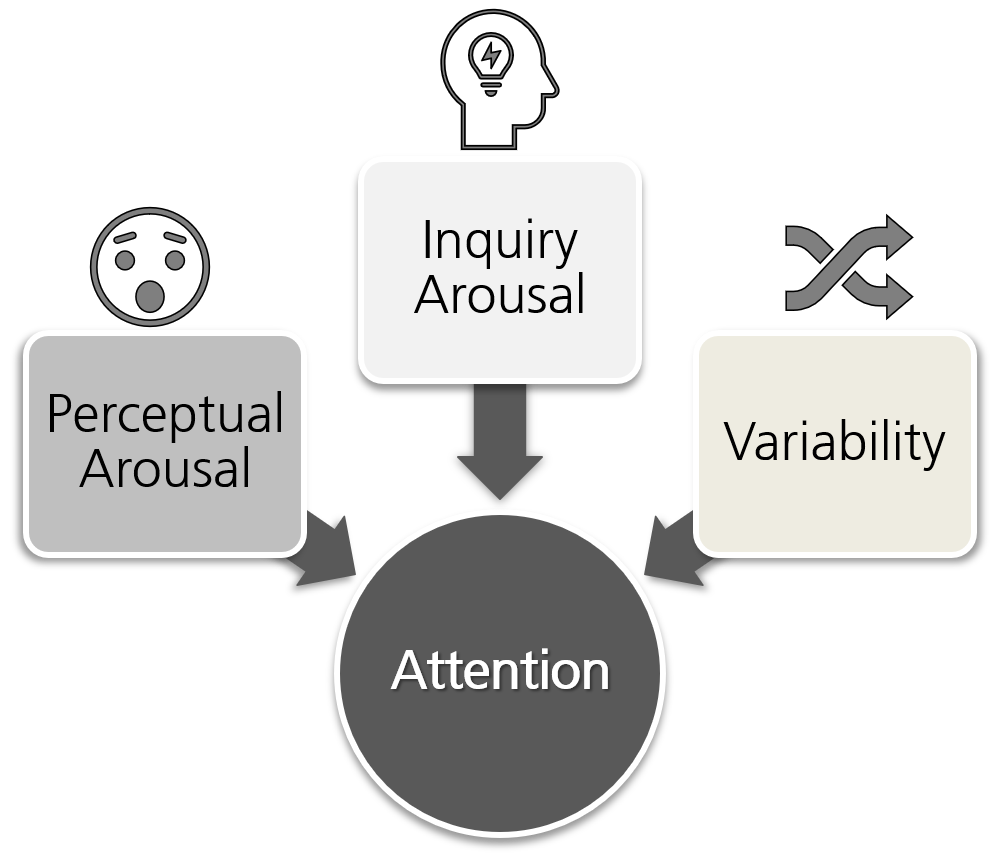
This component focuses on the ways that designers can create an e-learning that makes the learner sit up, lean in, and listen to the content. Keller wrote about this component in terms of “arousing” the interests and focus of the learner towards the material. Attention is delineated into three subcategories that each have their own strategies to employ: perceptual arousal, inquiry arousal, and variability.

Perceptual Arousal
Perceptual arousal is all about surprising the learner or presenting a topic in a novel way. An e-learning may open with a startling fact or statistic. It may begin with a scenario that presents a story of a situation gone wrong – showing the learner what they want to avoid doing. Key strategies include real-world examples, humor, incongruity, and conflict.
In an e-learning I recently developed for a national healthcare provider, I utilized perceptual arousal in a few different ways. Using the character template in Content Library 360, I created the character of Nurse Tonya who would act as the learner’s guide throughout this course. This character acted an LVN new to the telehealth department – much like the audience for the training. Nurse Tonya offered an opportunity for some humor and perhaps an unexpected element of the training.
To see for yourself, check out my Storyline 360 Sample.
Inquiry Arousal
Inquiry arousal entices the learner’s curiosity by presenting them with a challenging problem or situation that needs a solution. Asking some hard questions with real-life problems that the learner wants to solve get them curious and wanting to know more. Key strategies include active participation and brainstorming.
According to Bean, inquiry arousal is an essential part of motivating the learner by making them aware of their knowledge gap. She suggests that instructional designers, “Pose a series of questions at the beginning of the course that people are likely to get wrong. Confront them with the reality of what they’re missing and get them motivated to fill that gap” (p. 86).
Another strategy that you can employ is beginning the training with a short quiz or activity that the learner is likely to get wrong – and tell them that by the end, they will be able to answer it. After the learner has navigated through the training, have that same quiz or activity at the end. This not only helps the learner become more invested in the material, but it can also serve as a confidence booster as they get to see their improvement.
Variability
Variability is another key aspect of gaining a learner’s attention. The maxim “variety is the spice of life” exists for a reason. Even the most interesting template loses its impact after the third or fourth time a learner encounters it.
For content, slide after slide of text bullet points become monotonous rather quickly. Instructional designers should present content in a variety of ways to keep the material attention-grabbing. A combination of video, animation, and text are a sure way to go. Making that text interactive and fresh is also possible by using Content Library 360 templates like tabs, timelines, and other formats.
On the other hand, too much variability can feel chaotic and unorganized to a learner. If every slide presented is another new interaction, the learner may feel overwhelmed and unable to focus on the content; after all, there is such a thing as too much of a good thing.
So, how do we strike a good balance of repetition and variety? According to Bean, a good rule of thumb is to have 6 or 7 unique screen types within every 20 screens. This breaks down to introducing variety every three or four slides in a course.
Recap
And there you have it! The first piece of the motivation puzzle: Attention. By incorporating elements of perceptual arousal, inquiry arousal, and variability, you are sure to get your learners sitting up, leaning in, and engaged throughout your training course.
Stay tuned for the next post focusing on the second part of the ARCS Model for Motivational Design: Relevance.

Sources
- http://www.tamus.edu/academic/wp-content/uploads/sites/24/2017/07/ARCS-Handout-v1.0.pdf
- https://elearningindustry.com/arcs-model-of-motivation
- https://learningsolutionsmag.com/articles/2523/arcs-model-aids-in-designing-for-motivation
- https://www.flarelearning.com/post/22-leveraging-learning-theories-in-elearning
- https://www.amazon.com/Accidental-Instructional-Designer-Learning-Digital/dp/1562869140