

“R” is for “Relevance”
Establishing relevance is accomplished by explaining, in accessible language, how the new skill or information will help learners solve a problem that they’ve experienced, meet their needs, or enable them to enhance or apply skills they already possess. Modeling a desired behavior or using a desired skill is another way to establish relevance.
From Learning Solutions article “ARCS Model Aids in Designing for Motivation” by Pamela Hogle, 2017
So, you’ve gotten your learners hooked and gained their Attention through a bit of perceptual arousal, a splash of inquiry arousal, and a dash of variability. As attention-grabbing as the training now seems, learners will most likely not feel motivated to stick it out with the training unless that training also conveys its Relevance to their lives. Let’s take a closer look.

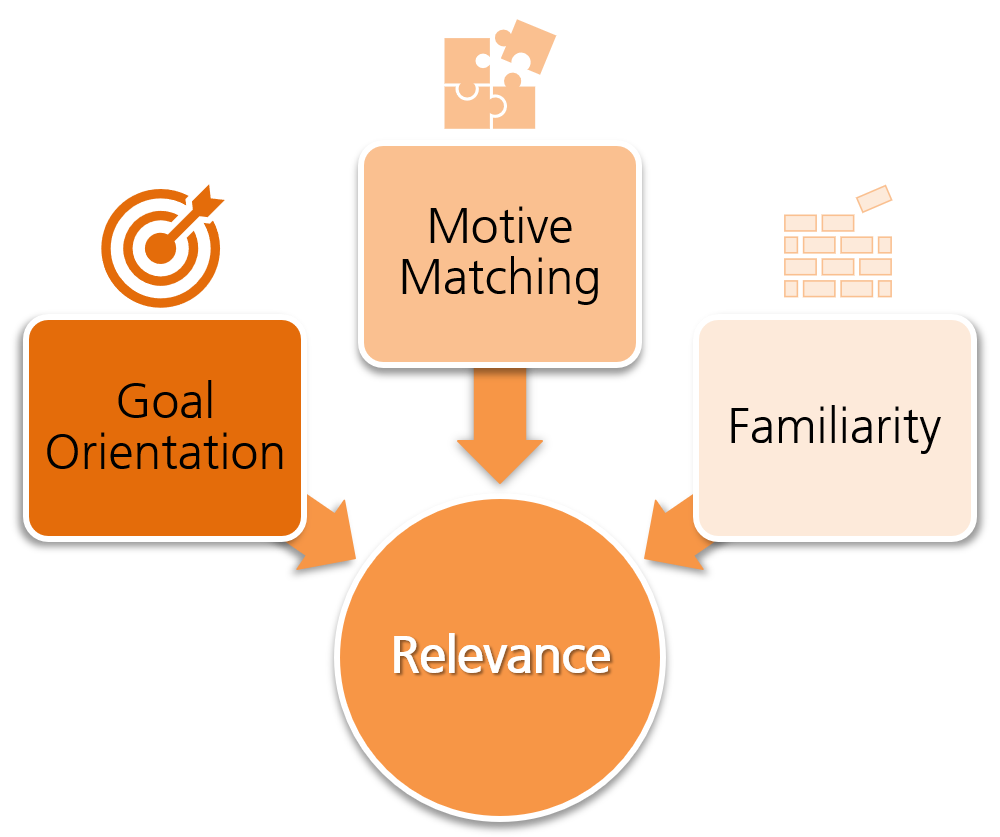
Goal Orientation
A key part of Relevance is helping the learner understand how the training materials and activities align with their unique goals.
The most common strategy that designers employ is presenting users with the Perceived Future Usefulness of the training. There may be a slide or section of the training somewhere around the Course Objectives that answers the question “What will this training do for me next week, next month, or next quarter?”
This focus on the Return on Investment (ROI) is naturally on a trainer’s mind, so it feels natural to present the learner with the long-term benefits of the training. However, this emphasis on long-term benefits may not be the most motivating for a learner. To go through the training, the learner must invest significant time and energy into absorbing and applying the new material on top of their other personal and professional responsibilities. Though we all know that short-term efforts often lead to long-term gains, busy learners don’t want to have to wait until next month or next quarter for their time/energy investment to pay off.
Learner’s want to know “What will this training do for me today?” To answer, Keller proposes boosting the learner’s Perceived Present Worth of the training by explaining how it will help with a current issue they are facing. When they are able to make a clear connection to the short-term benefits of the training their interest and motivation is immediately boosted.
Motive Matching
When designing training, our first priority is typically on meeting the needs of the company or organization that will result in some greater gain. However, a learner’s individual motives for learning are not the same as the business.
Keller argues that designers look for Needs Matching as part of Relevance. By assessing what drives the learner to take the training – whether for affiliation with the company, the sense of achievement, or the power that comes with gaining an edge in a skill or ability – the material can be designed with this in mind.
Additionally, there is nothing more demotivating that being railroaded onto a training track where the only direction is “Next Slide.” By allowing learners some freedom of Choice in how they engage with the material, Keller argues that learners will find it more relevant and engaging. This can be done in a variety of ways including:
- Survey the training audience to understand their preferred learning methods
- Utilize placement testing to allow a learner to “test out” of foundational materials
- Structure the training in a “choose your own adventure” style by allowing the learner to choose the order that they would like to view content modules
- Use a “flipped classroom” structure in which learners review content at their own pace asynchronously followed by a synchronous Q&A and/or application session
Familiarity
One of the most impactful concepts in adult learning theories is the idea of schemata. It’s crucial to recognize and draw upon the existing knowledge and skill base that our learner’s already have.
One strategy that Keller emphasizes is the need to Link to Previous Experience. Leveraging a learner’s existing skills and experience is the best way for them to be able to enhance and build upon them. Numerous studies have also shown that making connections between the new information and past schema ensure retention of the material.
A closely related strategy is the use of Modeling. By showing or telling the stories of role models using the training content and how it improves their lives, the learner is able to frame the training as the first step in their own personal success story.
In my training development, I like to incorporating Modeling with the scenarios I build. I create a fictional character (who has the same job responsibilities as the learner) who the learner must then guide through a familiar, real-world scenario utilizing the information from the training. When the character is excited and encouraged at the end of the scenario, the learner feels it alongside them and is able to apply the training.
Recap
And there you have it! The second piece of the motivation puzzle: Relevance. By incorporating elements of Goal Orientation, Motive Matching, and Familiarity, you are sure to get your learners taking notes and willing to invest their precious time and energy into your training.
Stay tuned for the next post focusing on the third part of the ARCS Model for Motivational Design: Confidence.

Sources
- http://www.tamus.edu/academic/wp-content/uploads/sites/24/2017/07/ARCS-Handout-v1.0.pdf
- https://elearningindustry.com/arcs-model-of-motivation
- https://learningsolutionsmag.com/articles/2523/arcs-model-aids-in-designing-for-motivation
- https://www.flarelearning.com/post/22-leveraging-learning-theories-in-elearning
- https://www.amazon.com/Accidental-Instructional-Designer-Learning-Digital/dp/1562869140